
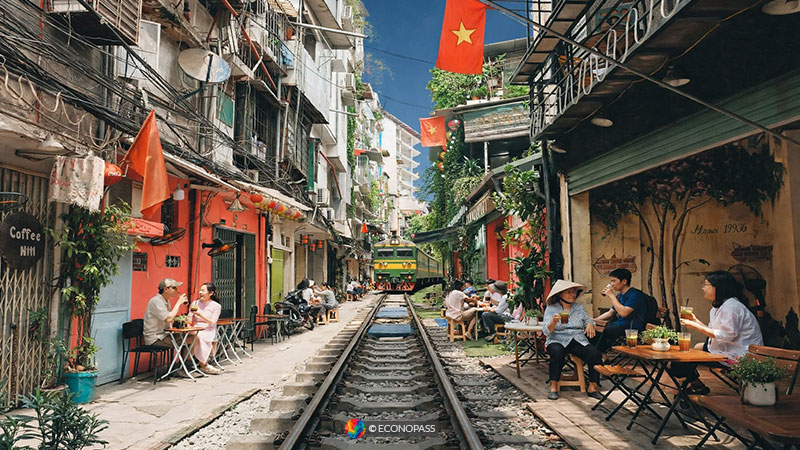
The sign at Hanoi Railway Station does not say thirty hours. Neither did the guidebook. The guidebook, a mid-price travel bible purchased the week before departure from a well-regarded publisher, was quite specific: seventeen hours from Hanoi to Ho Chi Minh City on the Reunification Express, the train that has been stitching the length of Vietnam together since 1976. Enough time to sleep, to watch the coast slide past, to eat whatever comes in the food trolley and feel, by arrival, that you have understood something about the country.
The actual journey takes between thirty and thirty-six hours, depending on the service. The discrepancy is not a rounding error. It is not a matter of interpretation. The guidebook had not been updated since 2009.
The Train That Reunified Vietnam
The Reunification Express is not metaphorical. When the last section of track connecting Hanoi to Saigon reopened on December 31, 1976, fourteen months after the fall of Saigon, it was a deliberate act of national statement. The French had built the original Transindochinois railway between 1899 and 1936. The American war destroyed large sections of it. Reunifying the line was understood, by the government that ordered it, as the physical completion of reunification itself.
The railway covers 1,726 kilometres and passes through every significant geographic zone in Vietnam: the Red River Delta, the Hai Van Pass, the central coastal plains, the Mekong approaches. At its slowest, on night services that stop at every provincial town, it takes closer to forty hours. At its fastest, on the SE1 and SE2 express services, it takes roughly twenty-nine.
No version of this train has ever taken seventeen hours. The figure in the guidebook did not correspond to any service that existed in 2009 either. What it corresponded to is unclear. Perhaps a projected schedule that was never implemented. Perhaps an error that was introduced early in the manuscript and never caught. Perhaps something simpler: nobody on the editorial team had been on the train.
Weirdly Useful Things Under $25
Real stuff, real low prices. Amazon's best-kept budget finds, picked for everyday usefulness, not just novelty.
Browse the FindsWhat Outdated Looks Like in Practice
The traveler who boards the Reunification Express in Hanoi expecting a seventeen-hour journey makes a series of downstream decisions based on that expectation. They book the connecting bus from Ho Chi Minh City’s outlying station for the following morning. They arrange to meet someone at a specific time. They bring food for a day, not a day and a half. They tell people at home when to expect a message confirming safe arrival.
All of those arrangements need to be rebuilt in real time, somewhere around hour eighteen, when the train is still several hundred kilometres north of its destination and shows no signs of urgency. The Ho Chi Minh City skyline does not appear at hour seventeen. The station platform does not appear at hour seventeen. What appears at hour seventeen, if the weather is clear, is the coast near Nha Trang.
Thomas Kohnstamm’s book Do Travel Writers Go to Hell? describes the guidebook industry from the inside, and the picture it paints is not reassuring. Kohnstamm wrote sections of a Lonely Planet guide to Colombia without visiting the country. He is explicit about why: the economics of guidebook production do not support the kind of research the covers imply. Deadlines are short. Advances are small. Updating an existing entry is cheaper than verifying it.
This is not specific to one publisher. It is a structural feature of the industry. A guidebook covering Vietnam, a country of 1,700 kilometres from north to south, with dozens of transport options, changing schedules, and a railway system that has been substantially upgraded in sections since 2000, cannot be verified in full by one or two researchers on a fixed contract. Something will be wrong. The question is only which something.
The Hai Van Pass at Hour Twelve
None of this is to say that the Reunification Express is a disappointing journey. It is, by most measures, one of the better train rides in Southeast Asia. The section through the Hai Van Pass, north of Da Nang, is legitimately extraordinary: the track clings to the cliff face above the South China Sea, exposed, slow, and completely unlike anything that appears in a railway advertisement.
Paul Theroux rode a version of this route in the late 1970s and wrote about it in The Great Railway Bazaar, his account of a journey from London to Asia by rail. Vietnam was not accessible to him at the time, but the trains of Southeast Asia that he did take share the quality he describes throughout the book: they are not efficient, they are not punctual, and they are entirely worth taking.
The specific pleasure of the Reunification Express is that it moves at the speed of the landscape rather than through it. The Hai Van Pass section alone, covering roughly twenty kilometres of track, takes the better part of an hour. From the right seat, in the right light, it is one of those stretches of railway that justifies the entire concept of train travel.
Graham Greene never took this train. He was in Vietnam in the early 1950s, before the railway had been fully reopened after the French war. But The Quiet American captures something that the Reunification Express also captures, in a different register: the sensation of a country moving at its own pace, by its own logic, independent of the schedule you arrived with.
Vietnam Railways, Schedules, and the Question of Sources
Vietnam Railways publishes schedules. The official website lists departure times, arrival times, journey durations, and seat classes. The information is current. It is also not the information that appears in most guidebooks covering Vietnam, because outdated guidebooks are a structural feature of the travel publishing industry, not an exception to it. Publishers are not updated on the same cycle as railway timetables.
The 2009 edition of the guidebook in question was not necessarily wrong in 2009. Vietnam Railways has made adjustments to schedules over the years, and the specific journey time for the full Hanoi to Ho Chi Minh City route has changed as infrastructure improvements have been completed in some sections and deferred in others. What is clear is that by 2024, seventeen hours bore no relationship to anything on the official timetable.
The traveler who discovers this discrepancy at hour eighteen is not, technically, the victim of a lie. The guidebook did not intend to mislead. It intended to inform, and it failed to do so, because the information it contained was fifteen years old and nobody had checked it. This is a distinction that matters less than it might seem when the connecting bus has already left without you.
The Practical Question
The practical question, the one that matters to someone planning to take this train, is simple: how long does it actually take? The answer depends on the service. The SE1 and SE2, the fastest trains on the route, take approximately twenty-nine to thirty hours under normal conditions. Slower services, particularly those stopping at all intermediate stations, take longer. Night trains vary. Delays for track maintenance, which are common, add time that cannot be predicted in advance.
Vietnam Railways’ own published schedules are the correct source for this information. So is the Man in Seat 61, a British website that covers train travel globally and is updated with unusual regularity. So is any travel forum post from the past two years. The guidebook published before 2020 is not a correct source, regardless of the publisher.
The Reunification Express is worth taking. The journey is long, and it is worth taking because it is long. The coast appears and disappears. The mountains come down to the water at the Hai Van Pass. The delta opens out south of Saigon. These things happen on the correct schedule, which is the train’s schedule, not the guidebook’s.
Not the highlights reel. Not the itinerary. Just what actually happened.
Simon De Lafronde
Sources
- The Man in Seat 61, Vietnam train travel guide
- Vietnam Railways, official schedules and timetables
- The Guardian, Taking the train through Vietnam (2008)
- Lonely Planet, Train travel in Vietnam
- Encyclopaedia Britannica, Vietnam: Transportation

A Note from Simon de Lafronde
The advice and information in this article come from my experience and research. It’s intended to support your reading with evidence-based insights. If the article is covering wellness or any other health topics, this is not professional advice. Please consult appropriate professionals for your specific situation.
📖 Read MoreStill Curious? Don't Stop Here!

He Bought an Authenticated Turquoise Stone in the Grand Bazaar. The Certificate Was More C...

The Night Market in Marrakech Is the Most Photographed Square in Africa. It Is Also the Mo...
They Crossed Into Myanmar Through a Border Town Listed as Safe. The Forum Had Not Been Upd...

The Island Was Listed as a Premier Snorkeling Destination. The Reef Had Been Dead for Six ...

Mount Everest Has Over 200 Bodies on Its Slopes. Most Are Used as Landmarks. The Families ...

Venice Has Fewer Than 50,000 Residents for the First Time in Six Centuries. On Peak Days, ...

They Posted Their Itinerary on Instagram. By the Time They Arrived at the Guesthouse, It W...