

The Scene
The Grand Bazaar in Istanbul has been open for business since 1461. It covers more than 30,000 square meters, contains over 4,000 shops arranged across 61 covered streets, and draws an estimated 15 million visitors annually. It is, by any measure, one of the most visited commercial spaces on earth.
Which is precisely why the transaction is so repeatable.
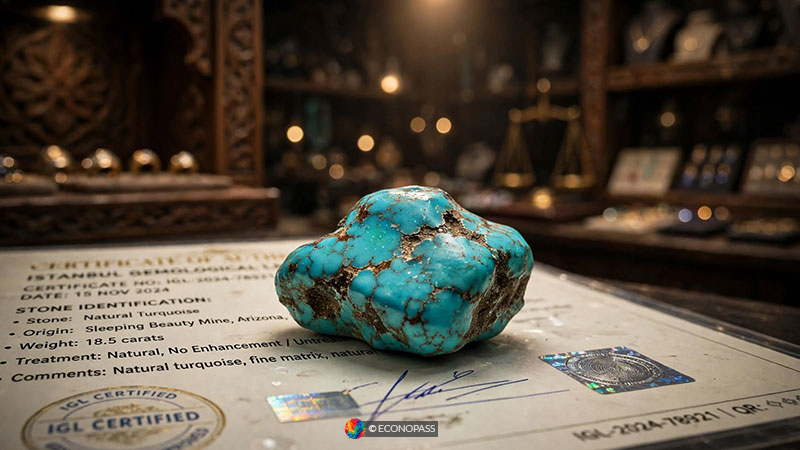
A traveler enters one of the jewelry and stone shops clustered in the gem quarter. The vendor is practiced: fluent in several languages, specific about the stone, quick with facts. He holds up a piece of turquoise, sky-blue with the characteristic grey-brown veining. The color is consistent. The veining looks right. Then the vendor produces a certificate.
The certificate has a shop seal. A signature identified as a gemologist’s. A printed declaration of natural origin, with what appears to be a registration number. It is laminated.
The buyer pays. The buyer leaves. The stone is not turquoise.
The certificate is always the more convincing part of the transaction. It is designed to be. The stone just needs to look right long enough to reach a shelf in another country.

Amazon Fire TV Stick 4K Plus
4K streaming with Dolby Vision, AI-powered search, and Wi-Fi 6. The most trusted streaming stick on Amazon.
View on AmazonThe Mineral They Are Selling Instead
The substitute has a name: howlite. It is a white calcium borosilicate mineral with microscopic pores and natural grey veining that runs through it in patterns that look remarkably similar to genuine turquoise matrix. Because it is porous, it absorbs dye easily and evenly. Dyed a robin’s-egg blue, it becomes visually indistinguishable from genuine turquoise to the untrained eye.
This is not a niche problem. Gem dealers document dyed howlite as one of the most widespread turquoise simulants on the market globally. The substitution is recorded across tourist markets in Turkey, Egypt, Mexico, and throughout Southeast Asia. It occurs with particular frequency in high-traffic destinations where buyers are unlikely to return for redress.
Dyed howlite sold as genuine turquoise has been documented across tourist markets on multiple continents. The fraud works because the visual similarity is genuine, not incidental.
The word turquoise comes from the French “pierre turquoise,” meaning “Turkish stone.” For centuries, some of the finest turquoise in the world moved through Turkish trade networks, arriving from mines in Persia, later Afghanistan and the American Southwest. The name stuck. The stone became iconic. And the association between Turkey and turquoise became, eventually, something a fraudulent certificate could exploit.
What the Certificate Actually Is
No formal international certification body exists for individual semi-precious stones at the retail level. Certificates for gemstones, when issued by legitimate entities, come from independent gemological laboratories: the Gemological Institute of America (GIA), the Swiss Gemmological Institute (SSEF), or the Belgian HRD Antwerp. These certifications are expensive, and they are not issued on-site in a Grand Bazaar shop.
What the buyer received was a document printed in that shop, or by a printer on a nearby street, bearing no accreditation traceable to any external laboratory or body.
A certificate issued by the shop selling the stone is not independent certification. It is a marketing document with a seal. The distinction matters enormously and is almost never explained at the point of sale.
The design is deliberate. It carries the visual language of authority: official fonts, bordered layouts, numbered entries, signatures in ink. Travelers conditioned to trust official documentation do what documentation is designed to make them do. They trust it. That is the transaction the shop is actually conducting.
The Scale of the Problem at the Grand Bazaar
In August 2025, Turkish police seized jewels and antiques estimated at $30 million from businesses inside the Grand Bazaar during an investigation into smuggled diamonds. The operation confirmed what traders in the market have stated openly for years: the problem of fraudulent goods at the bazaar is structural, not incidental.
Hasim Gureli, vice-president of the Grand Bazaar traders’ association, stated in 2024 that the bazaar has “lost its unique character” to counterfeit and misrepresented goods. A tea set seller with decades in the market used nearly identical language: “There is nothing but imported or counterfeit goods left and it’s getting worse every year.”
These are not outside critics. These are insiders describing their own marketplace.
Gemstone fraud sits at a different level from fake handbags. A fake handbag is verifiable by a knowledgeable buyer. A dyed howlite stone, sealed with a certificate and displayed under the warm lighting of a gem shop, requires laboratory equipment to definitively disprove. The barrier to discovering the fraud is built into the nature of the product.
The Commission System That Keeps It Running
The Grand Bazaar operates on a commission system that is not secret. Tour guides, taxi drivers, and hostel staff receive payments from specific shops for each tourist they deliver. The system creates incentives that do not align with the buyer’s interest: the guide has no stake in whether the stone is genuine. The guide has a stake in whether the buyer enters that particular shop.
What this means in practice is that a buyer who enters a Grand Bazaar gem shop through a recommendation from a “helpful local” or a tour guide is likely in a shop selected for conversion efficiency, not product quality.
The commission is built into the price. A stone that retails at a price that includes a 20 to 30 percent referral payment to a guide, plus the shop’s margin, plus the cost of producing the certificate, is not a stone that can also be a genuine natural gemstone at that price point. The arithmetic does not allow it.
The certificate, the commission, and the price are a system. Each element is calibrated to the others. The buyer’s confidence is the product being sold, not the stone.
How to Identify the Difference
Genuine turquoise has a Mohs hardness rating of between 5 and 6. Howlite sits at 3.5. A scratch test using a piece of quartz will mark howlite more easily than genuine turquoise. Under magnification, dyed howlite shows uneven color distribution along surface cracks and in porous areas, where the dye concentrates rather than integrates. An acetone test on an inconspicuous area may lift dye from surface-treated stones.
A copper reagent test will return negative for howlite. Genuine turquoise contains copper, which is responsible for its characteristic blue color. Howlite contains no copper. The test is conclusive.
None of these tests are possible at a Grand Bazaar counter. Which means the practical guidance simplifies to this: genuine untreated natural turquoise of any meaningful quality is expensive. If the price seems like a good deal for a turquoise stone sold with a certificate in a tourist market, the price is not reflecting the value of the stone.
What Happened to the Buyer
The buyer discovered the problem months later, when a jeweler in his home country evaluated the stone. The jeweler needed approximately thirty seconds.
This is the typical arc of the transaction. The buyer is no longer in Istanbul when the discovery happens. The shop cannot be located again from a tourist receipt. The Grand Bazaar has over 4,000 shops. The certificate is not traceable to any external authority. The stone is dyed howlite. The loss is absorbed.
No complaint is filed in Turkey. No claim can be made. The laminated certificate sits in a drawer, still looking more convincing than the stone ever was.
Not the highlights reel. Not the itinerary. Just what actually happened.
Simon De Lafronde
Sources
- Jewels and antiques worth $30M seized in raid at Istanbul’s historic Grand Bazaar, PBS NewsHour, August 2025
- Grand Bazaar loses its character, no thanks to fake items, The Star, 2024
- Dyed Howlite: The Ubiquitous Turquoise Simulant, SkyJems
- How to Tell the Difference Between Turquoise and Dyed Howlite, Gem Rock Auctions
- Grand Bazaar, Istanbul, Wikipedia

A Note from Simon de Lafronde
The advice and information in this article come from my experience and research. It’s intended to support your reading with evidence-based insights. If the article is covering wellness or any other health topics, this is not professional advice. Please consult appropriate professionals for your specific situation.
📖 Read MoreStill Curious? Don't Stop Here!
The Night Market in Marrakech Is the Most Photographed Square in Africa. It Is Also the Mo...
They Crossed Into Myanmar Through a Border Town Listed as Safe. The Forum Had Not Been Upd...

The Island Was Listed as a Premier Snorkeling Destination. The Reef Had Been Dead for Six ...
Mount Everest Has Over 200 Bodies on Its Slopes. Most Are Used as Landmarks. The Families ...
Venice Has Fewer Than 50,000 Residents for the First Time in Six Centuries. On Peak Days, ...
They Posted Their Itinerary on Instagram. By the Time They Arrived at the Guesthouse, It W...
The Ferry to the Island Left on Time. The Return Ferry Was Cancelled Due to Weather. They ...