


There is a version of productivity advice that insists you should do your hardest, most creative work at your peak hour. Wake up early, protect your mornings, attack your most demanding tasks when your mind is sharpest. It is tidy advice. It is also, for a specific category of work, exactly wrong. Research on how the brain generates insight suggests that creative breakthroughs are not products of peak focus. They tend to arrive in the opposite condition: when your guard is down, your attention is loose, and your brain is doing something that looks a lot like nothing.
The distinction the research draws is between two kinds of cognitive work. Analytical problems reward sharp, focused attention. You need to hold multiple variables in mind, test hypotheses, suppress distractions, and follow a logical chain. Peak cognitive hours serve this well. Creative problems are different. They often require a connection between ideas that are not obviously related, a link that focused attention actively suppresses because it looks like a distraction. The very mechanism that makes you good at analytical work makes you worse at insight.
A 2011 study by Mareike Wieth and Rose Zacks found that people solved insight problems significantly better during their non-optimal times of day. Morning people were more creative in the evening. Night owls showed more creative insight in the morning. The researchers called it the “inspiration paradox.” When your inhibitory control is slightly reduced, your brain entertains connections it would normally screen out. Those connections are where original ideas live.
The neuroscience behind this involves two brain networks that operate in rough alternation. The executive control network handles focused, goal-directed thinking. The default mode network, once dismissed as mere mental noise, activates when your mind wanders. It is now understood to be central to imagination, future planning, and the kind of associative processing that underlies creative insight. When you are tired, or distracted, or halfway between waking and sleep, the executive network loosens its grip and the default mode network has more room to operate.
This is why the shower works. Not because water is magical, but because showering is automatic enough to require almost no executive attention, which frees the default mode network to make connections across the ideas currently loaded in your mind. The same mechanism explains why solutions to stubborn problems often appear during a walk, during the half-awake state before sleep, or during a task so familiar it requires no real thought. You are not slacking. You are creating the cognitive conditions under which insight becomes possible.
John Kounios and Mark Beeman spent years recording what happens in the brain in the moment of insight. Using EEG and fMRI, they found a characteristic burst of high-frequency gamma wave activity in the right temporal lobe approximately 300 milliseconds before a person consciously experiences an “aha” moment. The insight was already formed in the brain before the person knew they had it. It did not arrive through deliberate effort. It surfaced from below.
Daniel Pink’s synthesis of the chronobiology research adds another layer. Most people follow a predictable daily pattern: a peak in the morning, a trough in the early-to-mid afternoon, and a rebound in the late afternoon or early evening. The trough, the period most people experience as their worst time of day, is actually well-suited to creative work precisely because vigilance and inhibitory control are at their lowest. The rebound is good for analytical work again. The mapping runs against most productivity advice, which defaults to protecting peak hours for everything demanding without distinguishing between the kinds of demands involved.
There is a practical implication here that requires some honesty about what kind of work you are actually doing. If you need to generate genuinely new ideas, recombine disparate concepts, or find the frame for a problem you have been stuck on, scheduling that work for your sharpest hours may be counterproductive. The conditions your brain needs to produce insight are not the conditions it needs to execute a plan. Knowing which one you need, and when your brain is actually in the right state for it, changes what the optimal schedule looks like entirely.
The most creative people are often not the ones with the most disciplined focus. They are the ones who have learned, consciously or not, to give their mind the unstructured time and reduced vigilance it needs to make connections that focused effort cannot force. Rest is not the enemy of creative work. For a specific and important kind of creative work, it is the method.
Your worst hour of the day may be the best hour you have for the problem you are actually trying to solve. The trick is knowing which problem you are holding.
Now you know. The question is what you do with it.
Marco Bellinari



Sources
- Inspiration Paradox: Creative Thinking at Non-Optimal Times (Psychological Science, 2011)
- Neural Activity Observed in People Solving Verbal Problems with Insight (PNAS, 2006)
- Default Mode Network and Creative Cognition (Neuropsychologia)
- The Default Mode Network (APA)
- Gamma Oscillations and Insight Problem Solving (PubMed Central)
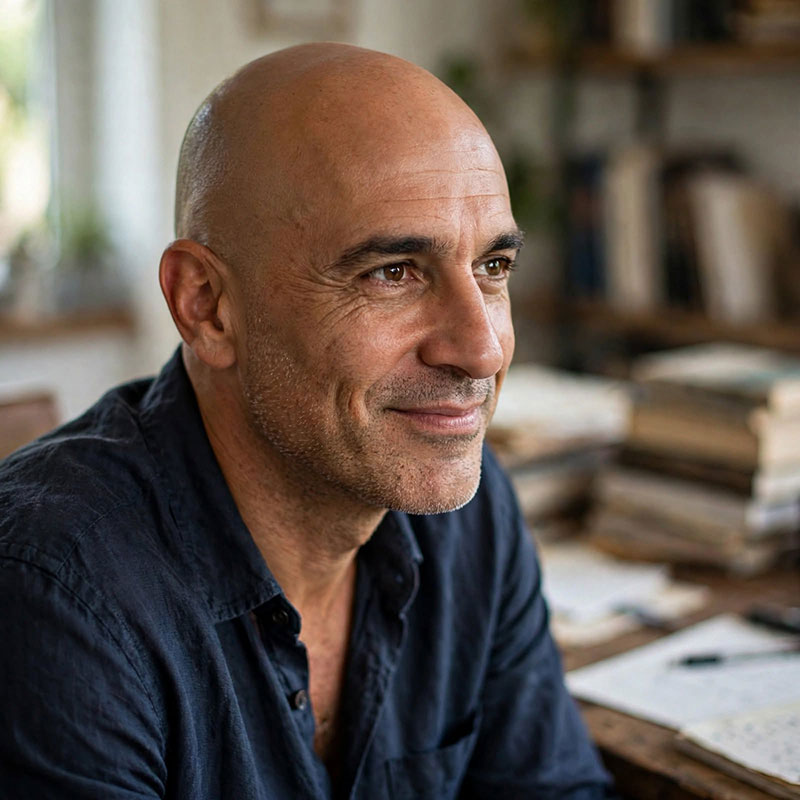
A Note from Marco Bellinari
Thank you for reading. Every fact in this article is documented and sourced. You will find the references at the bottom if you want to dig further. I hope it surprised you at least once. That is always the intention.
I would love to hear your thoughts. Follow Econopass on social media and share your reaction hereafter as a social comment. And if you do not want to miss the next story, hit follow. There is always another forgotten truth waiting to be told.