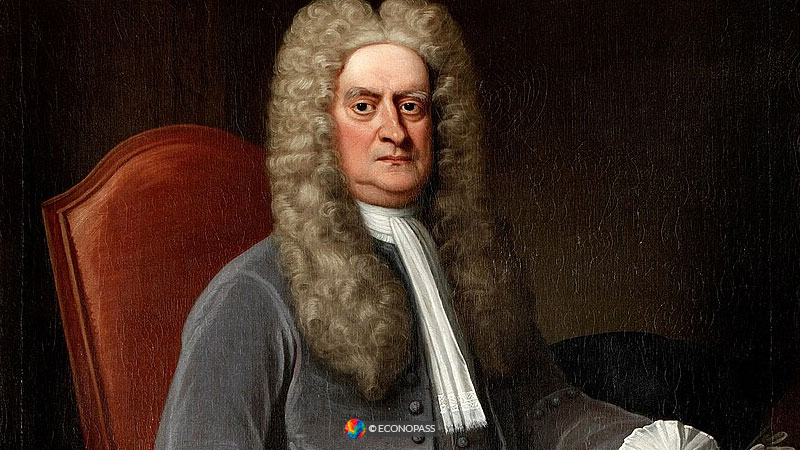
The apple story is one of the most durable myths in the history of science. Newton sits under a tree. An apple falls. Gravity is discovered. It is the kind of story that gets told to children because it compresses something vast and complicated into a single image that fits inside a single sentence. The problem is that it did not happen that way, and the real story is considerably more interesting.
What Newton actually did took roughly twenty years, involved a bitter dispute with another scientist, required him to invent a new branch of mathematics along the way, and came within a hair of never being published at all. The apple, if it happened in any form, was a starting point, not an ending. And starting points are not discoveries.
What the Apple Story Actually Claims
The story originates with Newton himself, told late in his life to his nephew’s wife, Catherine Conduitt, and later repeated by Voltaire, who popularised it across Europe. Newton described seeing an apple fall and being prompted to think about why objects fall toward the earth. He did not claim the apple hit him on the head. He did not claim the fall of the apple produced a complete theory. He claimed it started a line of thinking.
The orchard at Woolsthorpe Manor still exists. The tree, or a descendant of it, is still there. What is missing from the orchard is any evidence that a full theory of universal gravitation can be produced by watching fruit fall. It cannot. What it can do is prompt a question. Newton was already the kind of mind that could spend twenty years answering one.
The year usually associated with the apple is 1666, when Newton retreated to Woolsthorpe to escape an outbreak of plague in Cambridge. He was twenty-three years old. He would not publish his theory of universal gravitation for another twenty-one years. The gap between those two dates is where the real story lives.
The Mathematical Problem Nobody Mentions
To prove that gravity works the way Newton suspected, he needed to show that a sphere pulls objects toward its centre with the same force as if all its mass were concentrated at that point. This is not obvious. It is not even close to obvious. A sphere is made of an infinite number of small pieces, each at a different distance and angle from the object being attracted. Showing that they all add up correctly requires a form of mathematics that did not exist when Newton had his orchard moment.
So Newton invented it. What we now call calculus was developed in part because Newton needed a tool that did not yet exist to prove a theory he already suspected was true. He kept this largely to himself for years, sharing fragments with almost no one. The mathematics alone, setting aside the physics, was one of the most significant intellectual achievements of the 17th century, and it was a means to an end.
Newton did not publish his calculus for decades. When Leibniz independently developed a similar system and published it first, the resulting priority dispute consumed the European scientific community for years and poisoned Newton’s final decades. The apple story contains none of this. It contains a tree and a moment. Real discovery contains decades and damage.
The Role of Edmond Halley
In 1684, eighteen years after the orchard, the astronomer Edmond Halley visited Newton in Cambridge with a specific question: what shape would a planet’s orbit be if the force of gravity decreased with the square of the distance? Newton answered immediately: an ellipse. Halley asked how he knew. Newton said he had calculated it. Halley asked to see the calculation. Newton could not find it.
What followed was one of the most consequential acts of scientific patronage in history. Halley returned to London, wrote to Newton, and essentially asked him to redo the calculation and share the results. Newton spent the next eighteen months producing not a calculation but an entire book: the Principia Mathematica, published in 1687. Halley paid for the printing himself when the Royal Society declined on grounds of cost. Without Halley asking the right question at the right moment, and then funding the answer, the Principia might not have existed.
The Principia did not appear because Newton had a sudden idea under a tree. It appeared because a friend asked a question, Newton could not find his old notes, and the only way to answer properly was to write one of the foundational documents of modern science from scratch. Deadline pressure has produced stranger things, but rarely more important ones.
Why the Myth Persists
The apple story persists because it serves a purpose the true story cannot serve. It makes genius legible. It suggests that great insight arrives in a moment, that nature delivers its secrets to those who happen to be sitting in the right place. It is comforting in the way that all creation myths are comforting: it gives a beginning to something that otherwise has no clean beginning.
The true story is less comforting and considerably more instructive. It suggests that discovery is not a moment but a practice, that the gap between a question and its answer can be measured in decades, that the tools required to answer a question sometimes have to be invented first, and that even the greatest minds in history sometimes could not find their notes. The apple gave Newton a question. Twenty years of work gave the world an answer. The two things are not the same, and only one of them changed physics forever.
Every story has a version. I’m sharing mine. Marco Bellinari
As an Amazon Associate, Econopass earns from qualifying purchases.
A Note from Marco Bellinari
Thank you for reading. Every fact in this article is documented and sourced. You will find the references at the bottom if you want to dig further. I hope it surprised you at least once. That is always the intention.
I would love to hear your thoughts. Follow Econopass on social media and share your reaction hereafter as a social comment. And if you do not want to miss the next story, hit follow. There is always another forgotten truth waiting to be told.
Disclosure: This article may contain affiliate links. This means we may earn a commission if you click on a link and make a purchase at no extra cost to you. This applies to featured Amazon products or any other Econopass's partners.
These articles and stories are free because of a few ads. To support us, simply turn off your ad blocker for Econopass. It takes one click on the ad blocker icon in your browser. Thank you!
We use cookies to ensure that we give you the best experience on Econopass website. If you continue to use this site we will assume that you are happy with it.