
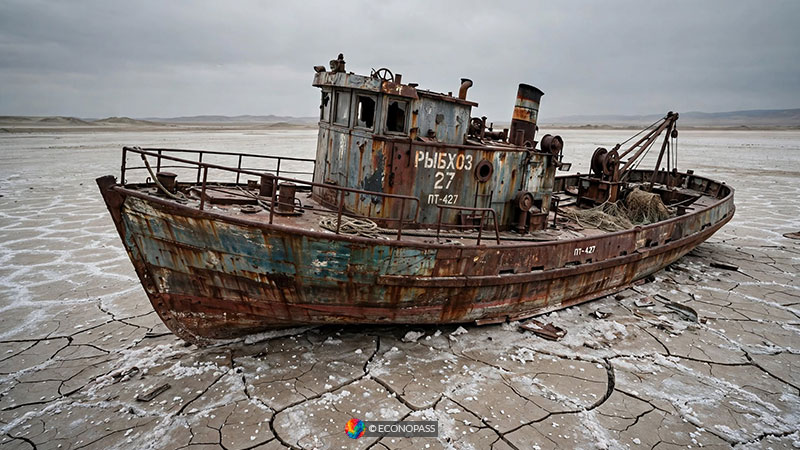
The ships did not sink. There was no storm, no collision, no catastrophe of the kind that sends vessels to the bottom. They simply stayed where they were anchored while the water retreated around them, year by year, until there was no water left. By the time the sea had receded far enough that the ships were sitting on dry sand, the fishing industry that had built the ports and crewed those vessels had already ceased to exist. The town of Moynaq in what is now Uzbekistan was a functioning port city in the 1960s. It is now forty kilometres from the nearest water. The ships are still there.
The Aral Sea was once the fourth largest lake in the world by surface area, covering approximately 68,000 square kilometres across what were then Soviet territories in Kazakhstan and Uzbekistan. By 2007 it had shrunk to ten percent of its original size. The southern portion has now largely become a desert called the Aralkum. The ships are a monument to a decision made in Moscow decades before any of the people affected by it were consulted, and they are one of the most visited and most photographed sites of ecological catastrophe in the world.
What the Soviet Union Decided
The Aral Sea was fed by two rivers: the Amu Darya in the south and the Syr Darya in the north. Both rivers originate in the mountains of Central Asia and had historically flowed into the sea, maintaining its level across centuries of variation in rainfall and snowmelt. In the 1950s and 1960s, Soviet planners decided to divert these rivers to irrigate the surrounding desert for cotton cultivation. The project was ambitious. The Soviets intended to transform Central Asia into a major cotton-producing region, and the irrigation canals required for that project needed water on a scale that the two rivers could provide.
The Aral Sea was not part of the calculation. The planners were aware that diverting the rivers would reduce the inflow to the lake. Some internal documents suggest they understood the sea would shrink significantly. The decision was made anyway. Cotton production increased. The Aral Sea began its retreat.
The Aral Sea was not destroyed by accident or ignorance. The Soviet planners who diverted its feeder rivers knew the lake would shrink. They chose cotton. The sea paid the price over the following forty years.
Colin Thubron traveled through the post-Soviet Central Asian republics in the early 1990s, shortly after independence, and the account in The Lost Heart of Asia captures the region in the immediate aftermath of Soviet dissolution, when the full consequences of the irrigation project were becoming undeniable. The fishing industry was already finished. The towns along the former shoreline were dealing with an economy that had been built around a resource that no longer existed where they had expected it to be.

Apple AirTag 4-Pack (2nd Gen)
Keys, luggage, wallet, backpack — one per thing you cannot afford to lose. Works with Find My across hundreds of millions of Apple devices.
View on AmazonThe Ship Graveyard at Moynaq
Moynaq was a fishing port with a cannery that employed much of its population. At its peak, the town processed significant quantities of fish from the Aral Sea, and the Soviet Union marketed canned Aral Sea fish as a regional product. The port was functional through the 1970s. By the 1980s, the shoreline had retreated far enough that the boats could no longer reach open water. By the early 1990s, the sea had withdrawn beyond any realistic reach of the town.
The vessels that were moored at Moynaq when the water retreated were left in place. Moving them would have required resources and purpose that the collapsing Soviet system and the newly independent Uzbek state were not in a position to provide. They corroded slowly in the desert air, which is now thick with salt and pesticide residue blown from the dry seabed. Visitors who travel to Moynaq today find a small collection of rusting hulks arranged in sand, surrounded by desert that was open water within living memory. Some of the ships have collapsed into themselves. Others are intact enough to be recognisable as fishing vessels.
The ships at Moynaq did not sink. The water left them behind. They have been sitting in sand for decades, corroding in air that carries salt from a seabed that was once forty metres deep.
What the Retreating Water Left Behind
The environmental consequences of the Aral Sea’s shrinkage extended well beyond the fishing industry. The exposed seabed carries salt, pesticide residue, and fertiliser that accumulated over decades of agricultural runoff. Wind picks up this material and distributes it across the region. Studies have documented the health effects on populations living downwind: respiratory problems, elevated rates of certain cancers, and complications associated with the contaminated dust.
Murray Feshbach and Alfred Friendly Jr. documented the full scope of Soviet environmental destruction in Ecocide in the USSR, a systematic account of how the Soviet system’s prioritisation of industrial output over environmental health produced catastrophes across the country. The Aral Sea is among the most dramatic, but Feshbach and Friendly documented dozens of parallel situations where the same logic, the same willingness to treat natural systems as inputs to industrial processes, produced regional environmental collapses that took decades to become visible to outsiders.
The local climate around the former sea has also changed. The Aral Sea functioned as a moderating influence on the regional climate, keeping summers cooler and winters less severe than the surrounding desert. Without it, the region experiences more extreme temperatures. The agricultural productivity that the irrigation was meant to support has been affected by the same environmental degradation that the irrigation caused.
The North and the South
The fate of the Aral Sea is not entirely a story of irreversible loss. The northern section of the lake, which lies within Kazakhstan, has partially recovered following the construction of the Kok-Aral dam in 2005. The dam, funded partly by the World Bank, separated the northern portion of the sea from the southern portion and allowed the Syr Darya to refill it. Water levels in the northern Aral have risen. Fish have returned. The Kazakhstani port town of Aralsk, which also had ships stranded by the retreat, is again closer to open water than it was at the sea’s lowest point.
The southern portion, controlled by Uzbekistan, has fared differently. The Amu Darya continues to be heavily diverted for irrigation, and the southern Aral has continued to shrink. The Aralkum desert that has replaced it is one of the youngest deserts on Earth, having formed within living memory, and it continues to expand. What happens to the landscape, the infrastructure, and the people when a body of water this size disappears is documented by Alan Weisman in The World Without Us, which traces the long-term fate of human constructions when the conditions that supported them dissolve around them.
The northern Aral Sea is recovering. The southern portion is not. The Aralkum desert that replaced the southern section is one of the youngest deserts on Earth. It did not exist sixty years ago.
What Visitors Find Now
Moynaq has become a destination for travellers interested in ecological history and for photographers drawn to the visual drama of the ship graveyard. The journey to reach it is not simple. Moynaq is remote, the infrastructure in the region is limited, and the town itself has lost most of the population it had when it was a working port. What remains is a museum dedicated to the sea, a viewing platform overlooking the former harbour, and the ships themselves.
The desert floor around the ships is textured with salt crystals and scattered debris from the former seabed. The air has a quality that visitors consistently describe as unusual: dry, slightly chemical, carrying something that is not quite dust. The ships sit in silence that is not peaceful in the way that ordinary desert silence is. It is the silence of something that should not be there.
The scale of what happened to the Aral Sea is difficult to hold in mind while standing among the grounded vessels. The distance from Moynaq to the current waterline is not a short walk. It is an hour’s drive across what was once open water. The ships mark where the shore used to be. The shore is now forty kilometres away. The sea did not drain overnight. It left slowly, over decades, while the people who depended on it watched it go and continued to watch long after they could no longer reach it.
Not the highlights reel. Not the itinerary. Just what actually happened.
Simon De Lafronde
Sources
- Aral Sea: The sea that disappeared, BBC News
- World of Change: Shrinking Aral Sea, NASA Earth Observatory
- Aral Sea, Encyclopaedia Britannica
- Aral Sea’s eastern lobe disappears, The Guardian
- Moynaq Ship Graveyard, Atlas Obscura
A Note from Simon de Lafronde
The advice and information in this article come from my experience and research. It’s intended to support your reading with evidence-based insights. If the article is covering wellness or any other health topics, this is not professional advice. Please consult appropriate professionals for your specific situation.
📖 Read MoreStill Curious? Don't Stop Here!

She Tipped Generously at Every Stop in Japan. Every Single P...
They Posed Naked on a Sacred Mountain in Malaysia. Three Day...

She Asked for the Pyramids. The Driver Had Other Plans.

He Accepted a Drink from a Stranger at a Rooftop Bar in Bogo...
She Booked a Bali Villa Online. The Real Owner Showed Up on ...
He Fell into a Geyser at Yellowstone While Walking Off-Trail...
She Reported Her Rape to the Police in Dubai. She Was Arrest...