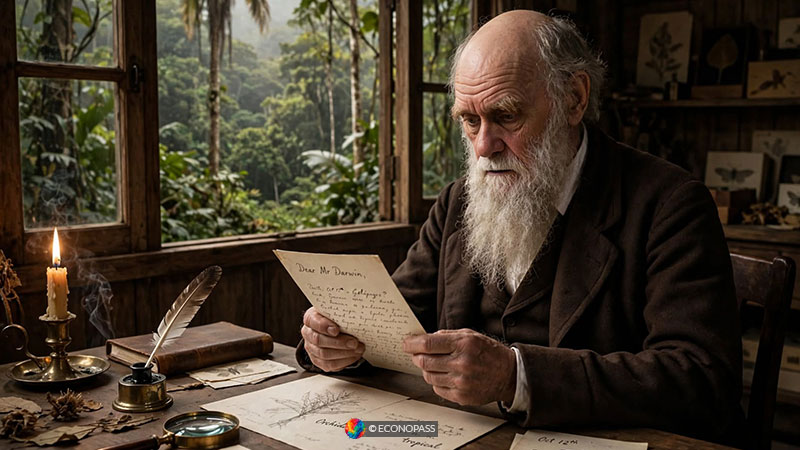
Charles Darwin is the name attached to the theory of evolution. It appears on the book, on the plaques, in the school curricula. What is missing from that story is a man named Alfred Russel Wallace and the letter he sent from a remote island in the Indonesian archipelago in 1858. Darwin had been sitting on his theory for twenty years. Wallace’s letter changed everything, and history has spent the time since then quietly forgetting his name.
Darwin began developing his ideas about natural selection in the late 1830s, following his voyage on the HMS Beagle. By 1844 he had written a substantial essay laying out the mechanism. He showed it to no one outside a small circle of trusted friends. He kept working, kept gathering evidence, kept delaying publication. Scholars have argued ever since about why. Fear of controversy, religious anxiety, perfectionism, all of these have been proposed. What is certain is that twenty years passed and the book did not appear.
In February 1858, Alfred Russel Wallace was lying ill with malaria on the island of Ternate when the idea came to him. He was a professional specimen collector, a self-educated naturalist who had spent years in the tropics sending beetles and birds back to wealthy patrons in England, Darwin among them. He wrote up his theory of natural selection in two days and mailed it to Darwin, asking him to forward it to the geologist Charles Lyell if he thought it had merit.
Darwin received the letter in June 1858. His response, in a letter to Lyell, has become one of the most quoted sentences in the history of science: “I never saw a more striking coincidence; if Wallace had my MS sketch written out in 1842, he could not have made a better short abstract.” The man working alone in the Indonesian jungle had arrived at the same mechanism, independently, and described it in terms that were almost identical to Darwin’s unpublished manuscript.
What happened next is a story about institutions, networks, and the way scientific priority gets assigned. Lyell and the botanist Joseph Hooker arranged for a joint presentation at the Linnean Society of London in July 1858. Darwin’s 1844 essay and a letter he had written to the American botanist Asa Gray in 1857 were read alongside Wallace’s paper. Darwin was not present. Wallace, still in the tropics, was not informed until it was done. The papers were presented together as a simultaneous discovery. Darwin then wrote On the Origin of Species in thirteen months and published it in November 1859.
The book made Darwin’s name permanent. Wallace’s paper, which had triggered the entire sequence of events, became a footnote. Wallace himself never expressed public bitterness about this. He called Darwin the Newton of natural history and spent the rest of his life defending the theory they had both arrived at independently. He outlived Darwin by thirty years and died largely celebrated but rarely centered in the story he had helped create.
The question of priority has been debated carefully by historians of science. Some argue that Darwin’s 1844 essay and his 1857 letter to Gray establish his claim beyond doubt. Others point out that without Wallace’s letter, Darwin might have delayed for another decade, or longer, and that the theory as the world knows it was shaped by the urgency Wallace’s arrival created. The thirteen-month writing of On the Origin of Species was not Darwin working at his natural pace. It was Darwin racing.
Wallace’s own contribution extended well beyond the 1858 paper. He developed his own elaborations of evolutionary theory, some of which Darwin disagreed with. He coined the term “Darwinism” himself, which is either generous or ironic depending on how you read the history. He continued publishing significant scientific work into his eighties. His book on island biogeography, The Malay Archipelago, remains a classic of natural history writing. He is not forgotten by specialists. He is simply not the name that comes to mind when the word evolution is spoken.
The letter that arrived in June 1858 was the forcing event. Without it, the theory of evolution by natural selection might have remained in Darwin’s drawer for years more. The book that changed biology was written in a hurry, because a self-educated naturalist with malaria on a remote island had independently worked out the same idea and was about to publish it. That part of the story is real. It is just not the part that gets told.
History has a way of settling on one name when two people arrive at the same place. The name it settles on is usually the one with the better address, the better connections, and the finished book. Darwin had all three. Wallace had the letter, and then he had the footnote, and then he had the kind of belated recognition that arrives after the narrative has already hardened around someone else.
Every story has a version. I’m sharing mine. Marco Bellinari
The rabbit hole goes deeper. Go further. It is worth it.
The advice and information in this article come from my experience and research. It’s intended to support your reading with evidence-based insights. If the article is covering wellness or any other health topics, this is not professional advice. Please consult appropriate professionals for your specific situation.
Disclosure: This article may contain affiliate links. This means we may earn a commission if you click on a link and make a purchase at no extra cost to you. This applies to featured Amazon products or any other Econopass's partners.
These articles and stories are free because of a few non-intrusive ads. To support us, simply turn off your ad blocker for Econopass. It takes one click on the ad blocker icon in your browser. Thank you!
We use cookies to ensure that we give you the best experience on Econopass website. If you continue to use this site we will assume that you are happy with it.