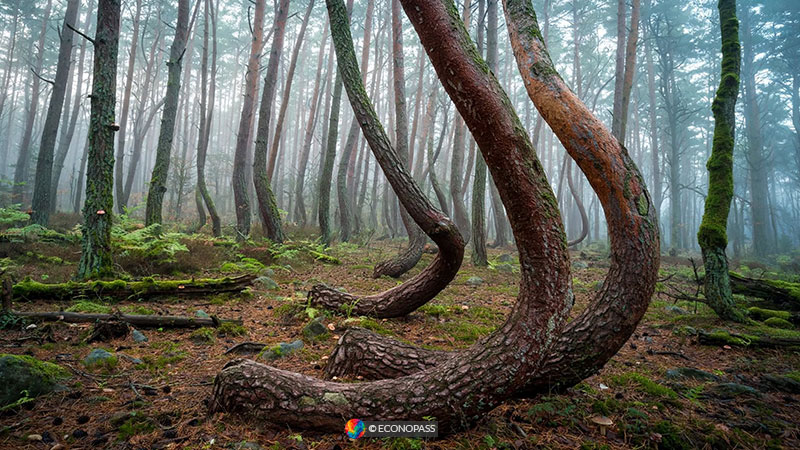
In the Gryfino Forest in northwestern Poland, there is a grove of approximately 400 pine trees that do not grow straight. Each one bends sharply at the base, curving northward by roughly 90 degrees before rising toward the sky. The curve is not gradual. It is not random. Every tree in the grove bends the same way, to the same degree, and then straightens into a perfectly normal trunk above the curve. They were planted around 1930. The people who planted them are dead. They left no record of what they intended or what happened.
The grove is called Krzywy Las in Polish, which translates simply as the Crooked Forest. It sits inside a larger forest of straight pines, which makes the effect stranger still. You walk through ordinary trees, and then you enter a grove where every single trunk bends at the same impossible angle, as if someone pressed pause on a wave. Scientists, foresters, and journalists have been trying to explain it for decades. Nobody has managed to do so with any certainty.
The Theories, Ranked by Confidence
The most widely cited explanation is that the trees were deliberately shaped by human hands. The leading version of this theory holds that farmers or craftsmen bent the young saplings shortly after planting, intending to grow curved timber for use in furniture, boat hulls, or yokes. Curved wood of a specific shape was valuable, and trees could be trained to grow that way if bent at the right age and held in position long enough.
The problem with this theory is that no record survives of who did it, why they chose this particular grove, or what the timber was intended for. The trees were planted around 1930, which means they would have been bent sometime between 1930 and 1940, a period that ended with the German invasion of Poland in September 1939. Whatever knowledge existed about the grove may have been lost in the war.
A second theory involves snow. Heavy, prolonged snowfall can press young saplings down and hold them flat against the ground for an entire winter. If the snow is deep enough and the trees young enough, they can retain a curve as they grow back toward the light. This would explain the consistent direction of the bend, since snow pressure would push all trees the same way on a slope. It does not explain why only this grove was affected while the surrounding forest was not, nor why the curve is so sharp and uniform across every single tree.
What the Trees Themselves Suggest
Dendrochronologists, scientists who study tree rings, have examined the Crooked Forest. The rings show a period of unusual growth that lasted approximately seven to ten years after the trees were planted. During this period, the trees were either held in a bent position or were responding to some external force. After that period, normal growth resumed. The curve was baked in, and the tree simply continued upward from wherever the curve ended.
This timeline fits both the deliberate shaping theory and the snow theory, and rules out neither. What it confirms is that something happened to these trees in the first decade of their lives that did not happen to any of the surrounding pines. Whatever that something was, it was consistent, localised, and complete. And then it stopped.
There is also a third theory, less discussed but not entirely dismissible: a gravitational anomaly or unusual soil condition specific to this patch of ground. This is considered the least likely explanation by most researchers, but the grove does sit in a geologically distinct area, and stranger things have been discovered about what soil and topography can do to root systems. It has not been ruled out so much as it has been set aside in favour of simpler explanations that also, so far, remain unproven.
Why the Mystery Has Not Been Solved
The Crooked Forest is not inaccessible. It is not dangerous. It is a grove of trees in a well-documented country that keeps detailed records. The reason the mystery persists is simpler than the mystery itself: the people who knew the answer died before anyone thought to ask them. The war erased not just lives but the institutional memory of a thousand small decisions that would otherwise have been passed down as local knowledge. What someone bent and why became, in the chaos of the 1940s, just another thing that nobody got around to writing down.
The trees are now between 80 and 100 years old. They are healthy. They are still bending. They will likely outlive several more generations of researchers who visit them, take measurements, propose theories, and leave without a definitive answer. The forest is not hiding its secret. It simply never had anyone left to ask.
The world is stranger than anyone told you. I am just keeping count. Marco Bellinari
As an Amazon Associate, Econopass earns from qualifying purchases.
A Note from Marco Bellinari
Thank you for reading. Every fact in this article is documented and sourced. You will find the references at the bottom if you want to dig further. I hope it surprised you at least once. That is always the intention.
I would love to hear your thoughts. Follow Econopass on social media and share your reaction hereafter as a social comment. And if you do not want to miss the next story, hit follow. There is always another forgotten truth waiting to be told.
Disclosure: This article may contain affiliate links. This means we may earn a commission if you click on a link and make a purchase at no extra cost to you. This applies to featured Amazon products or any other Econopass's partners.
FediBack: There Is a Forest in Poland Where All the Trees Grow in the Same Curved Shape. Nobody Knows Why.
🟢 Whatever knowledge existed about why those trees look the way they do may have died in the war before anyone thought to write it down. Does that change how you see the mystery? Tell me below.
🟢 Whatever knowledge existed about why those trees look the way they do may have died in the war before anyone thought to write it down. Does that change how you see the mystery? Tell me below.
🟢 Whatever knowledge existed about why those trees look the way they do may have died in the war before anyone thought to write it down. Does that change how you see the mystery? Tell me below.
These articles and stories are free because of a few ads. To support us, simply turn off your ad blocker for Econopass. It takes one click on the ad blocker icon in your browser. Thank you!
We use cookies to ensure that we give you the best experience on Econopass website. If you continue to use this site we will assume that you are happy with it.