

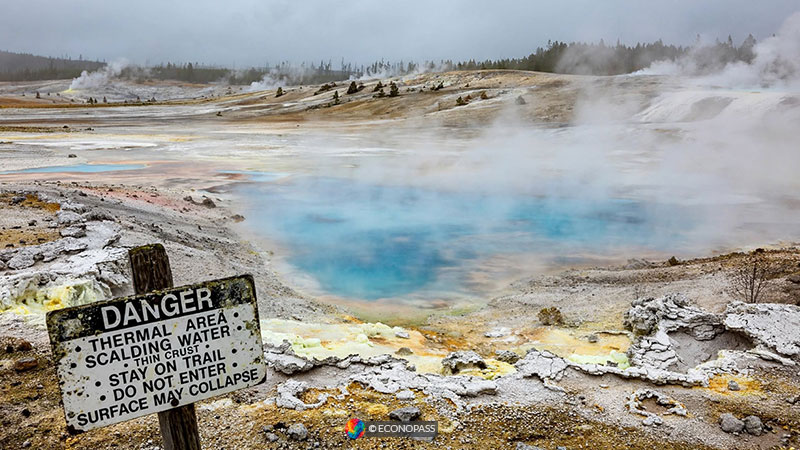
On June 7, 2016, a 23-year-old man from Oregon named Colin Scott walked off the boardwalk at Yellowstone National Park’s Norris Geyser Basin. He was with his sister. Investigators later found notes in his car suggesting he intended to soak in one of the thermal features, a practice known as hot potting that the park explicitly prohibits. He slipped and fell into a hot spring. The water temperature was approximately 93 degrees Celsius, or about 199 degrees Fahrenheit. It was also highly acidic. Recovery teams arrived within hours and attempted to retrieve his body. Lightning forced them to suspend the effort that evening. When they returned the following morning, there was nothing left to recover. The water had dissolved him overnight. The National Park Service confirmed that no remains were found.
What the Park Tells You
Yellowstone is not subtle about its dangers. The park posts signs at every thermal area. The signs say to stay on the boardwalk. They explain that the ground around thermal features can be thin crust over boiling water, that the water can reach temperatures well above the boiling point, and that stepping off the designated paths is prohibited. Rangers repeat the warnings. The park’s official safety materials describe the thermal areas as the most dangerous terrain in the park. The boardwalks exist because the ground beneath them cannot safely support a human being. This is not precautionary language. It is a description of the physical reality of the terrain.
Approximately four million people visit Yellowstone each year. A meaningful number of them step off the boardwalk anyway. Most survive. Scott did not. Lee Whittlesey’s Death in Yellowstone documents the full history of fatalities in the park since its establishment in 1872. The thermal features account for a significant portion of them. The pattern across the documented cases is consistent: a visitor leaves the designated path, usually briefly, usually without any apparent sense of serious risk, and encounters consequences that the terrain does not negotiate.
Yellowstone’s Norris Geyser Basin contains some of the hottest and most acidic thermal waters in the park, with temperatures that can exceed 93 degrees Celsius and acidity levels capable of dissolving organic material rapidly. The boardwalks are not a suggestion. They are the only surface in those areas that can safely bear human weight.

Blink Mini 2 Indoor Camera
1080p HD indoor/outdoor security, motion alerts, two-way audio, works with Alexa. Full peace of mind for under $40.
View on AmazonWhat the Water Actually Does
Norris Geyser Basin is notable among Yellowstone’s thermal areas for two characteristics that compound each other: extremely high temperatures and high acidity. The pH of the water in some Norris pools runs between 3 and 4, similar in corrosive strength to vinegar or stomach acid. At those temperatures and that pH level, organic material does not simply decompose over time. It breaks down rapidly. The combination of heat and acidity accelerates every chemical process involved in the dissolution of biological tissue. What took months or years in ambient conditions takes hours in superheated acidic water. This is not a dramatic interpretation of what happened to Scott. It is the straightforward chemistry of the environment he fell into.
Laurence Gonzales spent years researching why people make fatal decisions in wilderness environments. His findings, collected in Deep Survival, point consistently to a gap between a person’s mental model of an environment and the actual conditions of that environment. The hot spring at Norris does not look, from a short distance, like something that will dissolve a human body overnight. It looks like very hot water. The senses do not provide the information needed to accurately assess the risk. The signs exist because the senses cannot be trusted here.
The combination of superheated water and high acidity at Norris Geyser Basin accelerates the dissolution of organic material to a degree that is not intuitive from visual inspection. The water does not look different from the outside. The chemistry is extreme. These are not the same thing, and the gap between them is where the fatalities occur.
The Decision to Leave the Path
Hot potting has a history in the American West. In the early decades of Yellowstone’s existence as a national park, soaking in thermal features was practiced openly. The park eventually prohibited it as the death toll accumulated and the chemistry of the thermal areas became better understood. The prohibition is not arbitrary. The thermal features that look inviting, the ones with water temperatures close to body heat, are surrounded by features that are not survivable. A visitor who decides to evaluate the risk personally, without the information needed to make that evaluation, is making a decision about terrain they do not understand using senses that cannot detect what makes it dangerous.
Jon Krakauer’s Into the Wild examines a different wilderness fatality rooted in a similar structure: a young man who believed his preparation and instincts were sufficient for an environment that required specific technical knowledge he did not have. The details differ. The gap between what the person believed they were entering and what they actually entered is the same gap. Yellowstone makes the version of that gap visible on signs at every trailhead. The signs are not enough for everyone.
Investigators found notes in Colin Scott’s car suggesting he intended to soak in a thermal feature. Hot potting has been prohibited in Yellowstone since the park’s early decades. The prohibition exists because the features that look inviting are surrounded by features that are not survivable, and there is no reliable way to distinguish between them from the surface.
What the Record Shows
Scott’s case is the most documented thermal fatality in Yellowstone’s recent history, partly because of its completeness as a cautionary account and partly because of the detail provided by the NPS incident report. He is not the only person the thermal features have killed. Whittlesey’s record of deaths in the park documents more than twenty fatalities attributed to thermal features since the park’s founding. Several involved visitors who entered the water deliberately. Several involved people who fell in accidentally after leaving designated paths. In each case, the outcome followed directly from the chemistry of the water and the decision to be near it without the protection of the boardwalk.
Yellowstone receives more visitors each year than the population of Los Angeles. The thermal areas are among the most visited sections of the park. The boardwalks are there. The signs are there. The incident reports are public. The information required to make a safe decision in those areas is not hidden. What is required is the willingness to let the signs override the instinct that the water does not look that dangerous from here.
The world rarely matches the version sold to us. This is what it actually looks like.
Simon De Lafronde


Sources
- Death of Colin Scott, Wikipedia
- Norris Geyser Basin, Wikipedia
- Hydrothermal System of Yellowstone, Wikipedia
- Yellowstone Safety, National Park Service
- Yellowstone National Park, Wikipedia

A Note from Simon de Lafronde
The advice and information in this article come from my experience and research. It’s intended to support your reading with evidence-based insights. If the article is covering wellness or any other health topics, this is not professional advice. Please consult appropriate professionals for your specific situation.
📖 Read More