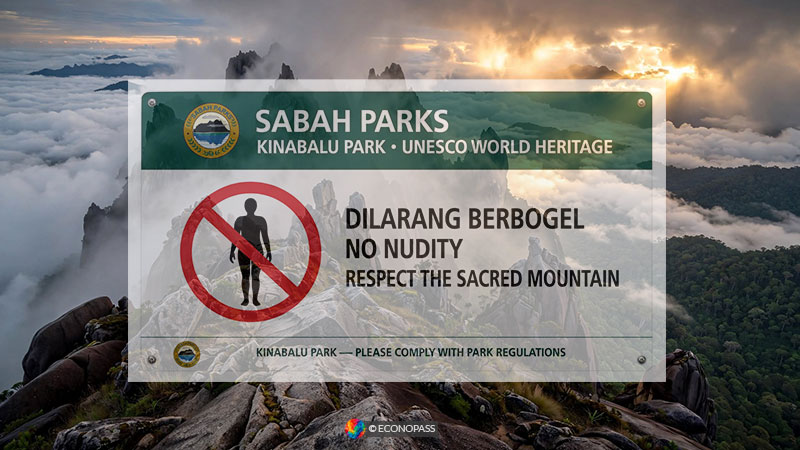
On May 30, 2015, a group of ten tourists reached the summit of Mount Kinabalu in Sabah, Malaysian Borneo. The mountain is 4,095 metres high, the highest peak in Southeast Asia outside of the Himalayas and the Karakoram. It is also considered sacred by the Kadazan Dusun people, the indigenous community of Sabah, who regard it as the resting place of ancestral spirits. At the summit, the group removed their clothing and posed for photographs.
On June 5, 2015, six days after the photographs were taken, a 5.9 magnitude earthquake struck the mountain. Eighteen people were killed, most of them primary school students on a government-organised hiking trip. More than a hundred others were injured. Boulders broke loose from the granite ridgeline. Trails collapsed. Guides who had spent years on the mountain said they had never experienced anything like it.
The Sabah government’s response to the disaster identified a cause. Chief Minister Musa Aman stated publicly that the earthquake had been triggered by the tourists’ behaviour at the summit. A local lawmaker called for the visitors to be charged for causing the disaster. The tourists, who were from Canada, the Netherlands, and several other countries, were arrested before they could leave Sabah.
Eighteen people died in an earthquake on Mount Kinabalu on June 5, 2015. The Sabah government blamed ten tourists who had posed for photographs at the summit six days earlier. The tourists were arrested.
What the Tourists Did and Did Not Do
The nudity incident at the summit was documented and is not in dispute. The group took photographs that subsequently circulated on social media. The images caused significant offence in Sabah and across Malaysia. Nudity at sacred sites is considered deeply disrespectful in Kadazan Dusun culture, and the photographs were described by Sabah officials and community leaders as a desecration of the mountain.
Local guides had attempted to dissuade the group from removing their clothing. The group proceeded regardless. One guide, Jude Thaddaeus, later stated that he had told them the mountain had rules and that what they were doing was wrong. The group did not listen.
The cultural insensitivity of the act is not a matter of serious dispute among those who have reported on the incident. What is a matter of dispute is the claim that the photographs caused an earthquake. Sabah’s response conflated two things: a genuine and serious breach of cultural respect, and a seismic event that had a documented geological explanation. The conflation served a political purpose and came at a cost to factual accuracy.
Our Pick
Anker PowerCore 10,000mAh
Charges an iPhone 3× over. Dual USB-C ports, pocket-sized, no cables needed at the airport.
The earthquake that struck Mount Kinabalu on June 5 was not unusual in a geological sense. Sabah sits within the Sunda Plate, a tectonically active region where earthquakes are a documented and recurring feature of the landscape. The Malaysian Meteorological Department confirmed that the earthquake was a natural seismic event. Geologists noted that the area around Kinabalu had experienced significant seismic activity over the preceding decades, and that the June 2015 event, while severe, was consistent with the region’s geological profile.
No seismologist or earth scientist attributed the earthquake to the presence of tourists at the summit, naked or otherwise. The geological record for the region does not suggest that human behavior at any point in recorded history has triggered a seismic event in Sabah. The mountain did not move because ten people removed their clothing at its peak.
The Malaysian Meteorological Department confirmed the earthquake was a natural seismic event. No earth scientist attributed it to the tourists. The Sabah government’s statement blamed them anyway.
The tourists who had been arrested were charged not with causing the earthquake, which is not a charge that exists in Malaysian law, but with committing an obscene act in public. Four of the ten were convicted and sentenced to three days in jail and a fine of 2,000 ringgit each. They served their sentences and were deported. The government’s public framing had suggested a causal connection to the deaths of eighteen people. The legal outcome reflected the actual situation: a public decency offence at a summit.
The Sabah Government’s Position and Its Consequences
The official attribution of the earthquake to the tourists created a specific problem for the families of the eighteen people who died. If the earthquake was caused by tourists who disrespected the mountain, the deaths become the consequence of that disrespect rather than the result of a natural disaster occurring in a geologically active zone with insufficient safety infrastructure for the number of visitors present.
Questions about why sixty-three primary school students had been taken up a 4,095-metre mountain, what emergency protocols were in place, and whether the trail system was adequate to handle the volume of hikers were effectively displaced by the government’s narrative. The focus moved to the tourists. The structural questions about how the mountain was being managed were not prominently pursued in official statements during the immediate aftermath.
Redmond O’Hanlon’s account of Borneo in Into the Heart of Borneo describes a landscape where the distance between the modern world and older systems of meaning is narrower than visitors typically expect. The mountain is not a backdrop. For the Kadazan Dusun, it is a living presence, and the protocol around it reflects centuries of relationship between people and place. That relationship does not become less real because visitors are unfamiliar with it.
The government’s statement displaced questions about trail safety and emergency planning. The tourists became the cause. The geology became irrelevant. Eighteen families buried their children.
What Travelers Are Not Told
Mount Kinabalu receives approximately 40,000 visitors per year. It is one of the most popular hiking destinations in Southeast Asia, well served by permits, guides, and accommodation at the Laban Rata rest house at 3,272 metres. The infrastructure around the mountain is designed for high-volume tourism. What is less systematically communicated is the cultural and spiritual framework within which the mountain exists for the people who have lived alongside it for generations.
Travel literature about Sabah and Borneo, including the kind of guide-focused writing that Thomas Kohnstamm examines in Do Travel Writers Go to Hell?, tends to describe Mount Kinabalu in terms of altitude, difficulty rating, and physical achievement. The cultural dimension is often a sidebar. The result is that visitors arrive with a framework oriented toward conquest and photography rather than toward the protocols that govern behaviour in a place that is, for its custodians, something more than a scenic destination.
The ten tourists who stripped at the summit in May 2015 were not, by the accounts available, malicious. They appear to have been thoughtless. Thoughtlessness at altitude, in a place whose significance they had not taken seriously enough to understand, caused genuine offence and genuine harm to a community’s relationship with a site they consider sacred. It did not cause an earthquake. The distinction matters, not to excuse the tourists, but because collapsing it served the interests of an official narrative at the expense of the people who actually died.
Whether the Sabah government ever seriously believed what it said publicly is not something the available record can resolve. What the record does show is that the statement was made, was widely reported, and shaped the international story of the earthquake for the weeks that followed. The tourists went to jail for indecency. The mountain was closed for a period and then reopened. The eighteen dead remained dead.
Not the highlights reel. Not the itinerary. Just what actually happened. Simon De Lafronde
Know before you go. These books will change what you see.
The advice and information in this article come from my experience and research. It’s intended to support your reading with evidence-based insights. If the article is covering wellness or any other health topics, this is not professional advice. Please consult appropriate professionals for your specific situation.
Disclosure: This article may contain affiliate links. This means we may earn a commission if you click on a link and make a purchase at no extra cost to you. This applies to featured Amazon products or any other Econopass's partners.
These articles and stories are free because of a few non-intrusive ads. To support us, simply turn off your ad blocker for Econopass. It takes one click on the ad blocker icon in your browser. Thank you!
We use cookies to ensure that we give you the best experience on Econopass website. If you continue to use this site we will assume that you are happy with it.