

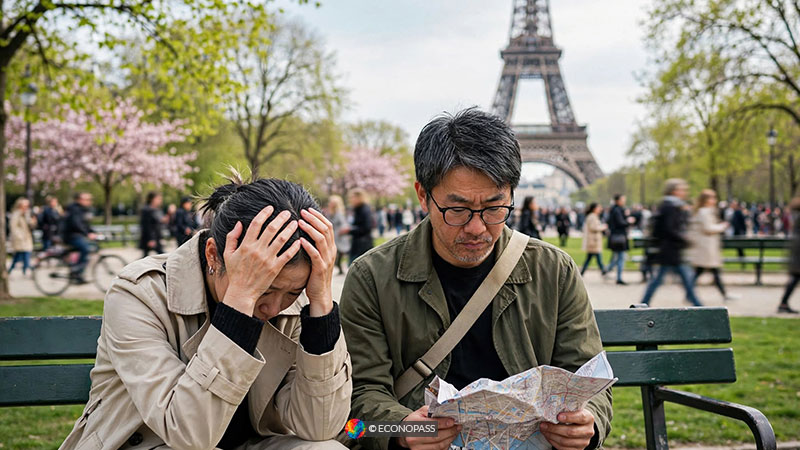
A city exists in the world. A different city exists in the imagination. For most of human history, the gap between the two was small enough to survive. For some visitors to Paris, it is not.
The City That Japan Built in Its Imagination
Japan has a particular relationship with Paris. Not with the actual city, but with a version of it that has been constructed, refined, and distributed across decades of fashion magazines, anime series, pop songs, and television commercials. In this imagined Paris, the streets are clean. The residents are elegant. The light falls the way it falls in impressionist paintings. The service is attentive. The croissants are flawless. Everyone behaves as though they are conscious of being part of something beautiful.
This version of Paris is not fabricated from nothing. It is assembled from real things. The fashion is real. The art is real. The architecture is real. But the city built from these fragments is a construction that no actual place can sustain for twenty-four hours a day, across eleven million people, through every season of the year. The gap between that construction and the functioning capital of France is, for most visitors, manageable. For others, it becomes something else entirely.
In Paris, for a specific category of visitor, that gap has a clinical name, a documented symptom profile, and a dedicated emergency hotline at a foreign embassy.
What the Fantasy Collides With
The real Paris is a functional European capital of eleven million people. It has pickpockets concentrated around every major tourist site, to the point where the Eiffel Tower is surrounded by signage warning visitors, in multiple languages, to guard their belongings. It has a Metro that is crowded, subject to strikes, and occasionally pungent. It has waiters who are not rude so much as operating under a different cultural grammar around service, one that reads as indifference to visitors expecting warmth. It has summer streets that smell in ways that arrive without warning.
Paris receives over 40 million tourists per year, making it the most visited city on earth. It is also the only city in the world with a psychiatric condition named after it, actively treated each year at a foreign nation’s embassy.
For the visitor whose image of Paris has been shaped over years by a culture that presents it as secular paradise, the collision with this reality does not simply disappoint. The service is not cold because they are being singled out. The streets are not dirty because something has gone wrong this particular week. This is what Paris is. The question is what happens in the mind of a visitor who cannot accept that answer.
When the Mind Cannot Close the Distance
Paris Syndrome was first identified and named in 1986 by Hiroaki Ota, a Japanese psychiatrist working in France, in a paper published in the French psychiatric journal Nervure. Ota described a pattern he had observed among Japanese patients: a cluster of acute psychiatric symptoms appearing specifically in the context of their visit to Paris, and resolving when the patient left or returned home.
The documented symptoms include visual and auditory hallucinations, acute delusions of persecution, feelings of unreality and depersonalization, severe anxiety, rapid heartbeat, nausea, vomiting, and sweating. In the most serious cases, patients require emergency psychiatric intervention and immediate repatriation.
These are not the symptoms of a bad holiday. They are the symptoms of a psychiatric episode triggered by the collapse of a world the patient had, over years, come to believe in. The condition is not caused by Paris. It is caused by what Paris was supposed to be, and by the specific psychological cost of discovering, in real time, that it is not.
Estimates place the number of cases severe enough to require repatriation at between twelve and twenty per year. A larger and uncounted number of visitors experience milder symptoms that go unreported. The condition is documented overwhelmingly in Japanese tourists, with smaller numbers noted among visitors from China and South Korea. It has not been widely documented in Western tourists, whose cultural relationship with the city generates a different kind of disillusionment, one that tends not to require a flight home.
The Hotline That Paris Does Not Advertise
The Japanese Embassy in Paris operates a 24-hour support line staffed by mental health professionals. It was established in response to the documented frequency of psychological breakdowns among Japanese nationals visiting the city. The service provides crisis support and, when necessary, coordinates repatriation for visitors who are no longer able to function in the country.
The existence of the embassy’s crisis hotline is not publicised by the French tourism industry. It is available because enough people have needed it to make its existence necessary.
The French response to Paris Syndrome has ranged from skeptical to dismissive. Some French psychiatrists have argued that the condition is not specific to Paris but simply a form of culture shock that could manifest anywhere. French media coverage has tended to frame it as a curiosity about Japanese visitors rather than as a question about the city’s own relationship with its marketed image.
A Parisian waiter having a difficult afternoon looks, from the outside, very much like a taxi driver in New York having one. Neither situation has generated a dedicated embassy crisis line. The difference, apparently, is what the visitor expected to find when they arrived.
That framing is worth examining carefully. The condition is named after a city, not after the nationality of the people who experience it. What Paris Syndrome describes is not fragility. It is the measurable psychological cost of a gap between a product and what the product actually is. The city sold one thing. The visitor arrived expecting it. The city could not deliver. And in some cases, that failure is not something that resolves with a good night’s sleep.
The world rarely matches the version sold to us. This is what it actually looks like.
Simon De Lafronde


Sources
- Paris Syndrome, Wikipedia
- Japanese Tourists Suffer Paris Syndrome, NBC News
- What Is Paris Syndrome? The Local France

A Note from Simon de Lafronde
The advice and information in this article come from my experience and research. It’s intended to support your reading with evidence-based insights. If the article is covering wellness or any other health topics, this is not professional advice. Please consult appropriate professionals for your specific situation.
📖 Read More