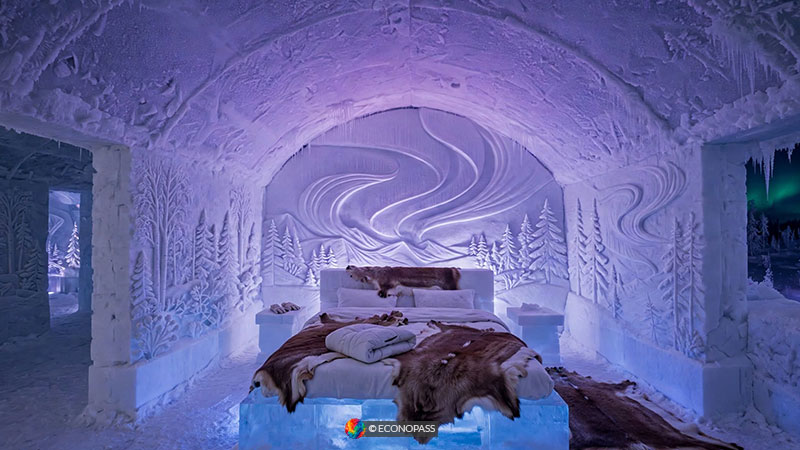
Every autumn, a team of artists and builders descends on Jukkasjärvi, a village of fewer than a thousand people in northern Sweden, 200 kilometres above the Arctic Circle, to construct a hotel from scratch. The walls are ice. The beds are ice. The bar, the reception desk, the art installations lining the corridors are all ice. Every spring, without ceremony, the whole structure melts into the Torne River it was carved from.
It has been happening since 1989.
The ICEHOTEL began almost by accident. A French artist named Jannot Derit came to Jukkasjärvi to exhibit ice sculptures. When the exhibition ended and accommodation ran short, some visitors slept in the igloo-style gallery itself, inside sleeping bags rated for extreme cold. They survived. They actually enjoyed it. The idea clicked.
The founder, Yngve Bergqvist, took the concept and scaled it into something that had never existed before: a fully operational hotel built from a material with a known expiry date.
The Numbers Are Not Small
Each winter construction requires roughly 30,000 tonnes of compacted snow and 10,000 cubic metres of ice harvested directly from the frozen Torne River. Hundreds of artists from around the world, selected through a competitive design process, carve the suites, sculpt the furniture, and install works that will exist for a maximum of four months before the April thaw begins.
The rooms hold temperatures between minus five and minus eight degrees Celsius. Guests sleep on blocks of ice topped with reindeer hides and thermal sleeping bags rated to minus thirty-five. The hotel provides Arctic suits, boots, and gloves. Check-in includes a briefing on how not to freeze to death in your sleep, which, in thirty-five years of operation, no guest has managed to do.
There is a chapel in the ice. Couples have married in it. The ice church hosts weddings every winter, and every spring the church, vows, altar, and all, melts away.
A Building That Cannot Last Is Still a Building
What makes the ICEHOTEL philosophically interesting is not the cold. It is the intentionality of impermanence. Every other building on earth is designed to resist time. The ICEHOTEL is designed to submit to it. The architects do not try to preserve it. There is no climate control system fighting the spring. When the river warms, the hotel returns to the river. The following autumn, it is drawn back out again.
This is not neglect. It is the model. The ephemerality is the point.
In 2016 the operators added a permanent wing called ICEHOTEL 365, kept frozen year-round by solar panels. Critics called it a contradiction. The original structure still melts on schedule every spring. The two versions coexist: one that submits to the season, one that does not. The guests who sleep in the seasonal wing understand they are sleeping in something that will be gone in months. That understanding changes the experience in a way no permanent building can replicate.
Ice as a Medium, Not a Material
The artists who design the suites are not interior decorators. They are sculptors working in a medium that has a deadline. Every carving, every arch, every carefully lit corridor will disappear. The work cannot be archived, cannot be sold, cannot be moved to a gallery. It exists for one season and then it does not exist at all.
Some artists find this liberating. The absence of permanence removes certain pressures. You are not making something for posterity. You are making something for now, for the people who will sleep inside it this winter, and for no one else.
Others find it devastating. To spend weeks carving something extraordinary and then watch it melt is not a comfortable experience. The hotel’s history includes artists who return year after year and artists who come once and never again.
The ice itself is not silent material. It cracks. It settles. Guests report hearing the building shift and groan through the night, the sound of a structure in slow negotiation with temperature. You are not sleeping in a static room. You are sleeping inside something that is, imperceptibly, always in motion.
The Village Behind the Hotel
Jukkasjärvi existed long before the ICEHOTEL and will exist long after any given version of it. The Sami people have lived in this region for thousands of years. The Torne River valley is Sami territory, and the relationship between the hotel’s operations and indigenous land use is not uncomplicated. Reindeer herding routes, traditional fishing practices, and winter ceremonial life all intersect with a tourism industry that draws 50,000 visitors per year to a village that otherwise has no particular reason for anyone to come.
The hotel has made Jukkasjärvi legible to the outside world in a way that changes what the village is. Whether that is a good trade is a question the village continues to answer for itself.
What is not in question is the strangeness of the thing. A hotel that dissolves every year. A building that the river takes back. An architecture of ice that has been continuously reinvented in the same location for thirty-five winters and counting.
The world is stranger than anyone told you. I am just keeping count. Marco Bellinari
Think that was strange? These books will finish the job.
The advice and information in this article come from my experience and research. It’s intended to support your reading with evidence-based insights. If the article is covering wellness or any other health topics, this is not professional advice. Please consult appropriate professionals for your specific situation.
Disclosure: This article may contain affiliate links. This means we may earn a commission if you click on a link and make a purchase at no extra cost to you. This applies to featured Amazon products or any other Econopass's partners.
FediBack: There Is a Hotel in Sweden Built Entirely of Ice. It Melts Every Spring and Is Rebuilt Every Winter.
These articles and stories are free because of a few ads. To support us, simply turn off your ad blocker for Econopass. It takes one click on the ad blocker icon in your browser. Thank you!
We use cookies to ensure that we give you the best experience on Econopass website. If you continue to use this site we will assume that you are happy with it.