

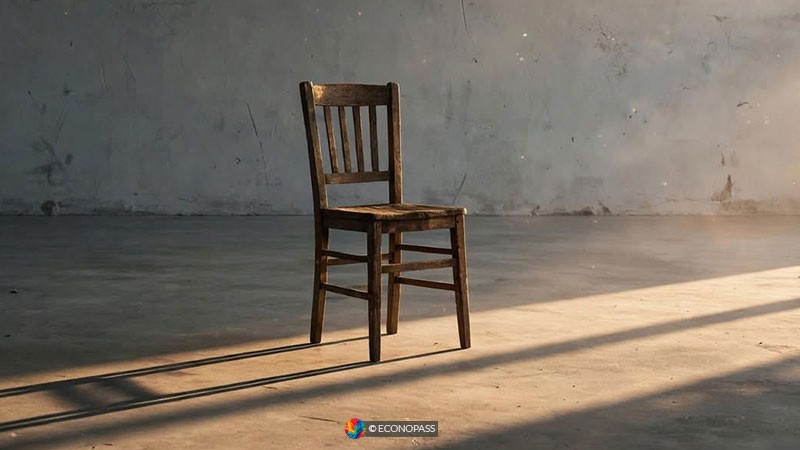
The apology happens before the thought does.
You walk into a chair. The word “sorry” is out before you have registered what you hit. That is not politeness. That is your brain running a program it cannot switch off, a program that was never designed for chairs.
The question worth asking is not whether this is strange. It is why a brain built by millions of years of evolution treats a piece of furniture as though it has feelings that can be hurt.
The System That Reads Minds
The human brain has a dedicated network for tracking other minds. Neuroscientists call it the social cognition network, and it involves several regions working in concert: the medial prefrontal cortex, the temporoparietal junction, the superior temporal sulcus. Together, these areas handle what researchers call theory of mind: the ability to infer what another being is thinking, feeling, or intending.
This system is not optional. It runs continuously. Its job is to scan the environment for agents, things that have goals, that can act, that might do something to you. It evolved to track predators, allies, and rivals. It is the reason humans can read a room, sense a threat before it materialises, and understand what a facial expression means without having to calculate it consciously.
The social cognition network does not wait to be asked. It runs in the background at all times, testing every stimulus in the environment for signs of agency.
The problem is that it was built for speed, not precision. And speed, in this case, means it fires before it checks.

eufy E25 Robot Vacuum & Mop
Powerful suction, mop combo, smart navigation, works with Alexa. Set it, forget it, come home to clean floors.
View on AmazonWhat Fritz Heider Proved in 1944
In 1944, psychologists Fritz Heider and Marianne Simmel ran an experiment at Smith College. They showed participants a short animated film. In it, two triangles and a circle moved around a rectangle on screen. That was everything. Geometric shapes. No faces, no voices, no context.
When asked to describe what they saw, nearly every participant told a story. The large triangle was a bully. The small triangle and the circle were a couple. They were trying to escape. The large triangle was chasing them. The circle was frightened. The small triangle was brave.
None of that was in the film. The film contained a large triangle, a small triangle, and a circle. The participants’ brains supplied everything else.
When shapes move in ways that suggest intention, the human brain assigns them personalities, emotions, and social relationships. It cannot help it. The social cognition system fires automatically on anything that moves with apparent purpose.
This was not a quirk of the participants. When the experiment has been replicated across cultures and demographics, the results hold. The brain is so primed to detect agents that it finds them in triangles.
The Evolutionary Argument for Getting It Wrong
There is a reason the system is set to fire early rather than late. Researchers studying the evolutionary origins of anthropomorphism use a framework called the Hyperactive Agency Detection Device, a term coined by cognitive scientist Justin Barrett.
The argument is straightforward. In an uncertain environment, two types of errors are possible. You can detect an agent that is not there, a rustling bush you mistake for a predator. Or you can fail to detect an agent that is there, a predator you mistake for a rustling bush. The first error costs you a moment of unnecessary alarm. The second error costs you your life.
Evolution selected heavily for the first type of error. A brain that over-detects agency survives. A brain that under-detects it does not. The result is a species that sees faces in clouds, hears voices in static, and assigns intentions to weather, to luck, to furniture.
Anthropomorphism is not a failure of reasoning. It is the output of a system optimised for survival in a world where failing to detect a threat was fatal and over-detecting one was merely embarrassing.
The chair is not a predator. The brain does not particularly care. It was built to flag the possibility, not to verify it.
Why the Apology Specifically
Understanding why the brain treats the chair as an agent explains the startle response. It does not fully explain the apology. For that, a second system is involved.
When you bump into another person, a social script activates. You have entered someone else’s space without permission. You have caused a minor violation of the social contract. The correct response, embedded by decades of conditioning, is an apology. It signals that the violation was unintentional, that you recognise it, that you are not a threat.
When you bump into a chair, two things happen simultaneously. The agency detection system flags the chair as a possible agent. And the social script for physical contact with others fires in parallel. The apology is the output of both systems running at once, before the conscious mind has had a chance to intervene and point out that the chair is not listening.
Mirror neurons, the cells in the premotor cortex that fire both when you perform an action and when you observe someone else performing it, are likely part of this loop. They were originally identified in macaque monkeys by researcher Giacomo Rizzolatti and colleagues in the 1990s. In humans, they are thought to contribute to empathy and social mirroring. When your shin hits the chair and you wince, the same circuits that process pain in another person activate. The apology follows as naturally as it would if you had walked into someone’s arm.
The System Has No Off Switch
People name their cars. They talk to their GPS when it gives bad directions. They feel genuine sadness when a robot is treated roughly in a video. Studies have documented all of these behaviors, and they are not explained by low intelligence or high suggestibility. They are documented across highly educated populations who would readily explain, if asked, that the car does not have feelings and the robot is not suffering.
Knowing something intellectually does not deactivate the system. Theory of mind and anthropomorphism operate below the level where conscious knowledge can override them. The same people who know the chair cannot be offended will still apologise to it. The knowledge and the behavior come from different parts of the brain, running at different speeds.
The apology is not evidence that you think the chair has feelings. It is evidence that the part of your brain responsible for social behavior is faster than the part responsible for categorising objects. Every time, without exception, the social system wins the race.
The chair got an apology. The brain was doing exactly what it was built to do.
Now you know. The question is what you do with it.
Marco Bellinari
Sources
- An Experimental Study of Apparent Behavior, Heider and Simmel (1944), American Journal of Psychology
- Theory of Mind, Wikipedia
- Hyperactive Agency Detection, Wikipedia
- Anthropomorphism, Wikipedia
- Mirror Neuron, Wikipedia

A Note from Marco Bellinari
Thank you for reading. Every fact in this article is documented and sourced. You will find the references at the bottom if you want to dig further. I hope it surprised you at least once. That is always the intention.
I would love to hear your thoughts. Follow Econopass on social media and share your reaction hereafter as a social comment. And if you do not want to miss the next story, hit follow. There is always another forgotten truth waiting to be told.
Still Curious? Don't Stop Here!

Talking to Yourself Out Loud Is Not a Sign of Instability. Scientists Have a Different Wor...

Once You Know Something You Cannot Unknow It. That Is Why Smart People Make the Worst Expl...

Doing Someone a Favour Makes You Like Them More Than Being Helped Does. This Has Been Docu...

You Can Hear Your Name Across a Crowded Room. You Were Not Listening. Your Brain Was.

Your Brain Rewrites Your Memories Every Time You Recall Them. Nothing You Remember Is Exac...

Why Boredom Is One of the Most Productive States Your Brain Can Be In

The Reason You Cannot Remember Being a Baby. It Is Not What You Think.