There is an animal living in the world’s oceans right now that has, as far as scientists can determine, no upper limit on its lifespan. When it grows old, or when it is injured, or when food runs short, it does not die. It reverses. It shrinks back through its own life cycle to its earliest juvenile form and starts again from the beginning. It has been doing this, in principle, since before the dinosaurs went extinct.
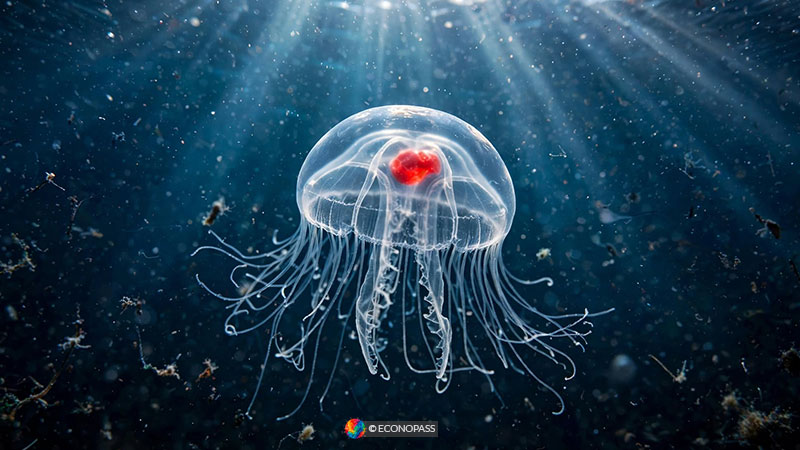
Its name is Turritopsis dohrnii. It is roughly the size of a human fingernail. It has a transparent bell, a bright red stomach visible through its dome, and between 80 and 90 tentacles. It eats plankton. It drifts. From the outside, it looks like a thousand other small jellyfish.
The trick lives inside its cells.
Turritopsis dohrnii is the only known animal capable of reversing its entire life cycle. The process is called transdifferentiation: the ability of a mature, specialised cell to transform into a different type of mature cell. In most animals, once a cell commits to being a muscle cell or a nerve cell, it stays that way for life. In this jellyfish, under conditions of stress or damage, fully specialised adult cells revert to a pluripotent state and reassemble into the polyp form the animal occupied at the start of its life. A new medusa buds off from that polyp and the cycle begins again.
In laboratory conditions, individual specimens have been documented completing this reversal more than ten times in succession. There is no known biological mechanism that prevents them from doing it indefinitely. The cellular hardware that causes ageing in most animals, the gradual accumulation of damage, the shortening of telomeres, the declining efficiency of DNA repair, appears in this jellyfish to be tuned differently. Genome studies have found that Turritopsis dohrnii carries expanded copies of genes involved in DNA repair, telomere maintenance, and stem cell renewal, and reduced versions of genes associated with cellular ageing. It is not that the jellyfish does not age. It is that it has a reset button.
The word immortal requires a large asterisk. In a laboratory tank, with stable conditions and no predators, a specimen could in principle persist indefinitely. In the actual ocean, it faces everything the ocean contains: predators, disease, pollution, fishing nets, temperature changes, and the full range of hazards that kill animals regardless of their cellular capabilities. Turritopsis dohrnii dies in the ocean constantly. What it does not do, under ideal conditions, is die of old age.
The animal was first described by German naturalist Johannes Gotte in 1883. Its remarkable life cycle reversal was documented by Italian scientists in the 1990s and published in a paper that initially attracted limited attention. It was a 2012 New York Times article by science writer Nathaniel Rich that brought Turritopsis dohrnii to mainstream awareness. Rich tracked down Shin Kubota, a Japanese marine biologist at Kyoto University who had spent years maintaining a colony of the jellyfish in laboratory conditions, carefully monitoring their reversals and singing them songs he had written in their honour. “Without this immortal jellyfish,” Kubota told Rich, “I cannot wake up in the morning.”
The scientific interest in transdifferentiation extends well beyond jellyfish biology. In transplant medicine, a cell that has been transdifferentiated would be considerably more stable than a stem cell, whose future development is harder to predict and control. The molecular mechanisms behind the jellyfish’s reversal may offer insights into age-related diseases, cancer biology, and cellular reprogramming. If scientists can understand precisely how a specialised adult cell forgets what it is and becomes something new, that knowledge could have direct applications in regenerative medicine.
There is also a philosophical complication buried in the biology. When an adult medusa reverts to a polyp, what exactly has continued? The DNA is identical. The genetic individual is, in the only sense that genetics makes the word meaningful, the same animal. But the adult medusa’s position in the water, its accumulated experience of light and current and prey, its particular relationship to every other organism it has encountered, all of that is gone. A new medusa will emerge carrying the same genome but no continuity of experience.
For a human, that would not be life extension. It would be closer to dying and being replaced by a clone who shares your fingerprints. The jellyfish does not appear to find this troubling. It has no central nervous system, no brain, no continuous memory in any sense we would recognise. Whatever the jellyfish is, the reset does not interrupt it. That question of what continues when everything that can be remembered is erased may be the strangest thing about the strangest animal in the ocean.
It is also, quietly, spreading. Turritopsis dohrnii was originally native to the Mediterranean Sea. Through global shipping traffic, it has now colonised oceans around the world. Specimens have been found in the Atlantic, the Pacific, the Indian Ocean, and the waters around Japan. It travels in the ballast water of cargo ships, deposited in ports far from its origin, establishing itself in new environments with no particular difficulty.
An animal that cannot die of old age is also, it turns out, an excellent traveller.
The world is stranger than anyone told you. I am just keeping count. Marco Bellinari
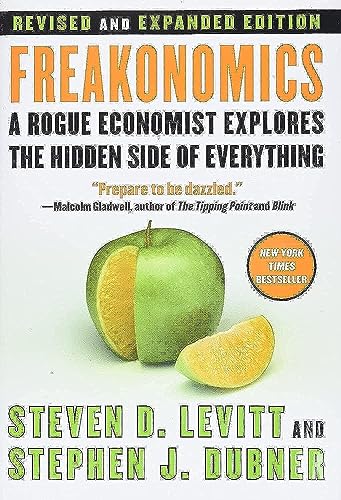
Think that was strange? These books will finish the job.
Thank you for reading. Every fact in this article is documented and sourced. You will find the references at the bottom if you want to dig further. I hope it surprised you at least once. That is always the intention.
I would love to hear your thoughts. Follow Econopass on social media and share your reaction hereafter as a social comment. And if you do not want to miss the next story, hit follow. There is always another forgotten truth waiting to be told.
Disclosure: This article may contain affiliate links. This means we may earn a commission if you click on a link and make a purchase at no extra cost to you. This applies to featured Amazon products or any other Econopass's partners.
These articles and stories are free because of a few ads. To support us, simply turn off your ad blocker for Econopass. It takes one click on the ad blocker icon in your browser. Thank you!
We use cookies to ensure that we give you the best experience on Econopass website. If you continue to use this site we will assume that you are happy with it.